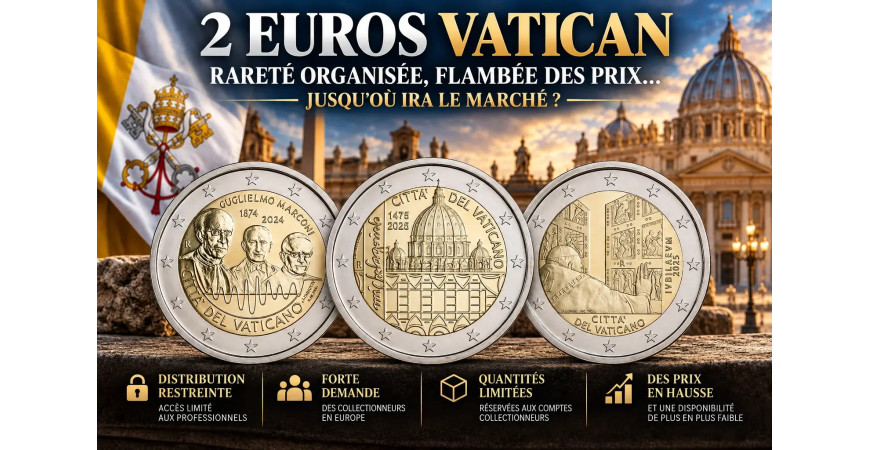
For several months now, the market for 2-euro commemorative coins from the Vatican is facing a particularly unusual situation. Issues that would once have been relatively accessible to European collectors are now becoming hard to find, while their prices are rising very rapidly.
This phenomenon is particularly evident in the Vatican's most recent broadcasts, including the 2-euro Guglielmo Marconi Coin, 2024, as well as the 2025 episodes dedicated to theHoly Year, , Michelangelo and to the Sede Vacante MMXXV.
This price increase cannot be explained solely by the number of coins minted.
The real change lies primarily in their distribution.
The Vatican has significantly changed access to its numismatic issues
For many years, numismatists were able to obtain certain Vatican coin issues through the usual distribution channels and then offer these coins to their customers.
The situation is much more complicated today.
Access to new releases has become particularly limited, and professionals no longer have the same sourcing options as before.
To obtain certain coins directly from the Vatican, it is necessary, among other things, to have a Active collector's account with the Vatican Philatelic and Numismatic Service (CFN).
However, just because you have an account doesn't mean you can order any quantity you want.
The quantities allocated are limited and depend on the options available to each collector.
This is an extremely important change for understanding current market trends.
A coin can have a large mintage and still be very hard to find
When discussing numismatic rarity, the first instinct is often to look at the mintage.
This is obviously an important factor, but it is not enough.
A coin may have been minted in tens of thousands of copies and yet still be extremely difficult to find if only a small number actually make it onto the professional market.
That is exactly what we are seeing right now with the Vatican.
A large portion of the coins is distributed directly to collectors registered with the Vatican.
These collectors generally purchase items for their own collections and do not immediately put them back on the market.
Professionals must then look for available copies from other collectors, foreign dealers, or directly on the secondary market.
And when several professionals are simultaneously looking for the same currencies, prices automatically rise.
Why are the prices of Vatican 2-euro coins rising so much ?
Several factors are currently coming together.
First of all, access to the rooms is restricted.
Furthermore, demand for Vatican coins remains extremely high in Europe. Many collectors wish to have a complete collection of the commemorative 2-euro coins issued since 2004.
So, just one missing piece prevents a set from being complete.
On top of that, there is now an additional challenge: The professional supply is extremely limited.
When a professional can no longer order 50, 100, or 200 copies of a program directly, they must gradually purchase the available copies on the market.
First editions can sometimes be found at a reasonable price.
But when these coins are no longer available, you have to turn to sellers who offer their coins at higher prices.
The purchase price is going up.
Then it goes up even more.
And the final selling price inevitably follows this trend.
It is this mechanism that accounts for much of the rise seen in recent Vatican bond issues.
The 2-euro Vatican coin, 2024, dedicated to Guglielmo Marconi illustrates this situation perfectly.
Demand is high, and the number of available professionals is extremely limited.
Available copies must now be sought out individually on the market.
As inventories are depleted, their value increases.
On The Euro Counter, the play is currently being performed at €199.89 (including tax).
This price may seem particularly high for a recent 2-euro coin.
But it's important to understand that the face value of the currency is practically irrelevant in this type of market.
What determines its value is now essentially:
-
its actual availability ;
-
its distribution method ;
-
international demand ;
-
the quantities available to professionals ;
-
and the price at which new shares can be repurchased.
2025: An Even More Exceptional Situation
The 2025 vintage adds another dimension.
The Vatican has witnessed a series of extremely significant historical events: Jubilee of the Holy Year, death of Pope Francis, the Sede Vacante period, and the election of Pope Leo XIV.
Several numismatic issues are directly related to this period.
These include, in particular:
2-euro coin, Vatican, 2025 – Holy Year
This program commemorates the 2025 Jubilee and depicts Pope Francis opening the Holy Door of St. Peter's Basilica.
2-euro coin, Vatican City, 2025 – 550th anniversary of Michelangelo
A program dedicated to one of the major artists of the Renaissance who is closely associated with the Vatican's artistic history.
2 euros Vatican 2025 – Sede Vacante MMXXV
Probably one of the most symbolic issues of that year. A coin directly linked to the period following Pope Francis’s death and preceding the election of his successor.
Once again, their price is directly linked to the extremely specific supply conditions.
Professionals must now purchase on the secondary market
This is probably the most important point to understand.
When a dealer can order a currency directly from the issuing institution, its purchase price is known and relatively stable.
When he has to buy that same currency from collectors or other professionals, the situation changes completely.
Each seller sets their own price.
If demand increases, the least expensive copies will sell out.
The following items are more expensive.
And then even more expensive.
Any business owner who wishes to continue offering this currency to their customers must therefore accept these new purchase prices.
That is exactly what is happening today with several Vatican programs.
Availability also depends on collector accounts
The current system further exacerbates this situation.
New issues are offered to collectors who own a active account with the Vatican, but quantities are still limited.
This means that there are potentially tens of thousands of pieces, but they are scattered among a very large number of collectors.
However, a coin found in 30,000 private collections is not necessarily a coin that is available for sale.
This difference between official draw and the actual quantity available on the market is essential.
In fact, it's probably one of the best indicators for understanding some of the current increases.
Is it a true rarity or a market rarity ?
We need to distinguish between two concepts.
The first is the an absolute numismatic rarity, determined in particular by the number of copies minted.
The second is the market scarcity, that is, the number of copies actually available at a given time.
The Vatican's most recent issues are currently in a unique situation: even when their print runs are not extremely small, their commercial availability is very limited.
It is this market scarcity that is currently driving up prices.
Could prices still go up ?
Of course, no one can guarantee how the numismatic market will evolve in the future.
It is entirely possible that more copies will gradually appear on the secondary market, helping to stabilize prices.
But the opposite is also possible.
If collectors who received their coins directly from the Vatican keep them and international demand remains high, the number of available coins could continue to decline.
In that case, professionals looking to restock will have to buy parts that are becoming increasingly expensive.
And prices could continue to rise.
A trend to watch for collectors of 2-euro coins
The Vatican has always held a special place in the collection of 2-euro coins.
Along with Monaco, San Marino, and Andorra, it is one of the small countries whose broadcasts traditionally attract a large audience.
But the current situation introduces a new factor.
The challenge is no longer simply to find a coin with a low mintage.
It now involves finding a coin that Distribution itself has become extremely limited.
This is a significant development in the market for commemorative 2-euro coins.
It also shows why one should never assess the rarity of a coin based solely on its mintage.
The number of copies actually available, distribution channels, and the ability of professionals to restock their inventory can have an equally significant impact on its value.
A Vatican vintage that might stand apart
In hindsight, the years 2024 and, above all, 2025 could prove to be a special period for Vatican numismatics.
The combination of major historical events, changes in distribution, and strong international demand is creating a situation rarely seen with such recent releases.
Collectors should therefore keep a close eye on these coins.
Not because a future increase is guaranteed, but because their actual availability today is very different from what their official circulation figures alone might suggest.
And in the numismatic market, It's not just the number of items that exist that matters: it's mainly the number of items you can actually buy.